The Wyman Intelligence Index
Structured assessments and digital companions
See your meetings and decision-making from a different perspective, with profiles to explore individually or in a facilitated conversation.
Understand your meetings. Examine your decisions.
You may be getting through the agenda and following up decisions, yet still wonder whether you are hearing the best thinking in the room. Or you may be meeting today’s targets without seeing what a decision could cost elsewhere, or further ahead.
Designed and built by me, these tools use your responses to a series of questions to explore patterns in your meetings and decision-making. They draw on more than twenty years of work with senior teams.
The Meeting Intelligence Index
Same meeting. Different experiences.
In around ten minutes, you answer questions about preparation and structure, participation and listening, quality of thinking, and decisions and follow-through. Your report considers the pattern across your answers, including your written observations.
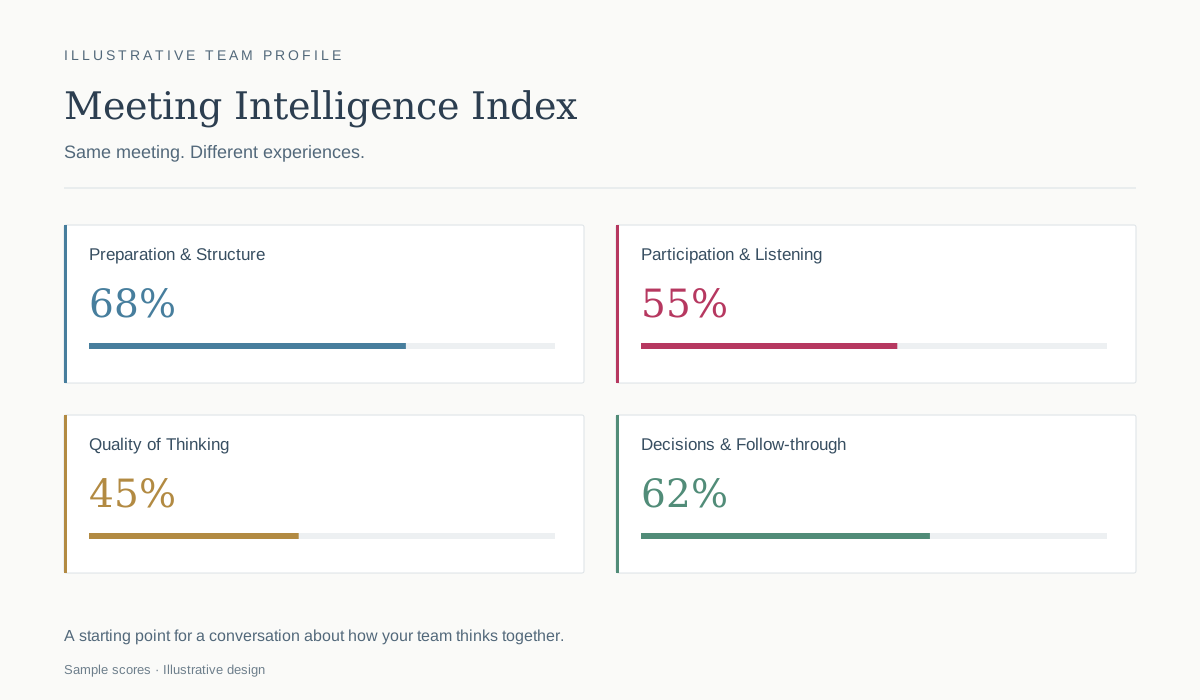
Illustrative team profile · Sample scores.
For you
Receive an immediate individual profile. Explore where your meetings support good thinking and where you experience constraints.
For your team
Each person completes the survey independently. A team report brings together averages and differences between responses, providing the basis for a facilitated conversation.
Your team may share the same meetings but experience them very differently. Those differences can open questions that an overall score would conceal.
Want to understand what is happening in your meetings? Let’s discuss a useful starting point for you or your team.
Book a conversation →The Organisational Intelligence Index
What gets attention when you decide?
Eleven questions invite you to examine what is visible in your organisation’s decision-making: different forms of value, consequences across teams and the balance between immediate pressures and the longer term. The final question asks you to reflect on a real, recent decision.
Your responses form the basis of a facilitated feedback and development session. Drawing on integrated thinking and reporting, we explore how different forms of value connect, what receives attention, what is harder to raise, and where decisions may have consequences across your organisation and over time. The OII is used within this process; it does not provide a standalone individual report.
Six forms of value
- Financial resources
- Budget, funding and sustainability.
- People & capability
- Skills, learning, capacity and wellbeing.
- Knowledge & expertise
- What your organisation knows and learns.
- Relationships & trust
- Connections within and across organisations.
- Community context
- The communities you serve and depend on.
- Natural environment
- Environmental consequences and resources.
An example: the wider consequences of adopting AI
Automating work may save time and release capacity. But what happens if that same work was how junior colleagues learned to exercise judgement? The OII gives you a way to bring less visible consequences into the conversation alongside the immediate benefits. This is an illustrative scenario drawn from the sample material.
The scale concerns visibility, rather than organisational performance. The survey is a starting point for development, not a ranking or a verdict on your organisation.
Have a decision you would like to examine more fully? We can explore how the OII could support a facilitated conversation.
Book a conversation →Digital companions for everyday decisions
Digital companions are short, guided reflection tools you can return to during the working day. Before a difficult conversation, after a demanding meeting, or when competing priorities make a decision hard to see clearly, they give you a place to pause, work through questions and consider your next step.
Before a difficult conversation
Prepare for a conversation you have been putting off.
When priorities compete
Notice how immediate demands and longer-term possibilities compete for your attention.
At the end of the week
Set down the week and consider what deserves attention next.
Human judgement stays at the centre
The assessments reflect participants’ answers; they are not independent observations of behaviour or measures of organisational performance. Differences and changes in responses are invitations to enquire further.
Parts of the tools use AI to generate a written reflection. It offers another perspective on the responses, to be questioned in the light of your knowledge of the situation. Some companions use guided questions without an AI response.
Find a useful starting point
Whether you want an individual perspective or a facilitated conversation with your team, we can discuss which tool would be useful for the question you are facing.
Book a conversation →